
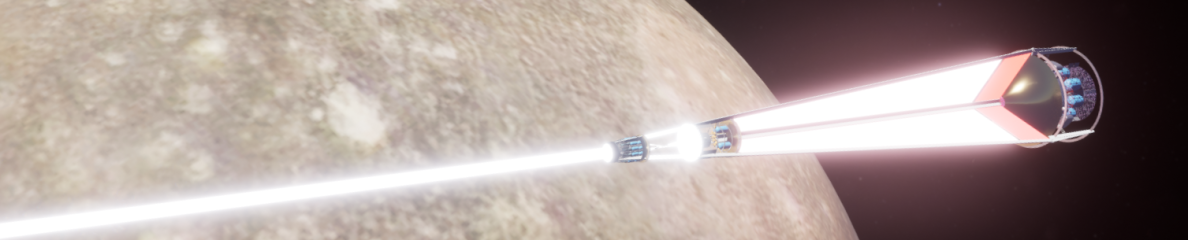
The main fields covered by this technical comittee are nuclear propulsion, both fission and fusion, solar wind, fision fuel acquisition and antimatter and advaced physics. Other technical comittees cover subjecst such as chemical propulsion, electric propulsion, mass drivers, space settlements and space materials.
For self study, the AIAA offers an Advanced Space Propulsion course . Prepared and presented by AIAA members and professionals of the Space Industry. It can be a great place to work on advanced studies. For less advanced studients, NASA also maintains a number of pages designed for young persons interested in space propulsion that present the basic concept in an accessible way.
I am interested in learning more about nuclear propulsion, like nuclear thermal rockets and similar concepts. What should I study?
The two primary propulsion methods in this category are based on either nuclear fission or nuclear fusion processes.
There are specific, non-technical courses that would be beneficial to someone new to the field due to the unique circumstances surrounding nuclear engineering. The ability to communicate effectively is an important attribute in any aspect of engineering, but especially in a field with many controversial opinions and misconceptions among the general public. Courses on public policy, nuclear proliferation policy and public relations will enhance your ability to clearly report any advancement to the public realm in more acceptable fashion. Courses on technical writing and proposal writing are essential for reporting on and seeking funding for your research. The ability to effectively work with and within cross-disciplinary teams is a necessity and is built, in part, by gaining relevant experience on technical teams. Necessary non-nuclear technical classes that provide valuable skills for this field are requirements definition, fault tree analysis, design of experiments, project management, and systems engineering. Additional optional technical courses could include orbital mechanics, propulsion sciences (rocketry), electrodynamics theory (physics), electrical engineering, and computer engineering. All of these bring different capabilities and skills to nuclear propulsion research.
There are many nuclear engineering programs that focus on the nuclear physics and processes that could be applied in a wide variety of applications from terrestrial power reactors to medical MRI machines. The structured curriculum and courses needed to obtain degree(s) in nuclear physics or nuclear engineering (e.g. neutron kinetics, thermal hydraulics, radiation, materials, etc.) are the requisite technical knowledge. In the nuclear fusion realm, the engineering of reliable and efficient fusion plasma containment schemes continues be a primary challenge, so courses in high-energy and plasma physics are required to fully understand these processes. Once the fundamentals have been provided, the systems engineering aspects of applying them to a particular concept become the key drivers in the design process supplemented by the other non-technical courses mentioned earlier.
Reactors for flight or space power are typically left to prime engine contractors or other national labs for development. Much of the research in fusion power that could potentially have applicability in space is being made by academia and the private sector rather than through government-sponsored initiatives.
Any colleges or businesses with credible research in nuclear power will be based on impartial and thorough work. The work should be careful and rigorous, including referencing other credible works in the nuclear field.
Colleges with Nuclear Engineering Programs (see US News report):
- University of Michigan, Ann Arbor
- Massachusetts Institute of Technology
- North Carolina State University
- Texas A&M University, College Station
- University of Tennessee Space Institute
- University of California, Berkeley
- University of Florida
- Missouri University of Science and Technology
- University of Alabama, Huntsville – Dr. Jason Cassibry cassibj@uah.edu
- University of Illinois, Champaign/Urbana – Dr. George Miley
- University of Maryland – Dr. Raymond Sedwick
- University of New Mexico. The Institude for Space and Nuclear Power Studies is a research and development organisation within the UNM School of Engineering.
I am interested in learning more about advanced physics-based propulsion, like wormholes and warp drives. What should I study?
Propulsion based on advanced physics is an area with very few financial and professional opportunities due to the significant lack of credible proof that such schemes are possible, limited experimental efforts, few personnel dedicated to such work and little to no interest beyond science fiction. While the development of advanced physics propulsion is considered extremely high risk and rarely worthy of investment, even the most basic validation in this field would revolutionize science and our understanding of physics. There are a large number of dubious successes and false claims in the surprisingly large body of published literature associated with these topics, so one should exercise caution when pursuing these interests so as to not be led down a wrong path.
In order to make that determination, however, work in this area requires scrupulous studies in theoretical physics and a deep understanding of subtopics like atomic physics, quantum physics, astrophysics, cosmology, gravitational physics and both general and special relativity. Other concentrations, like high-energy physics, plasma physics and propulsion sciences would provide favorable backgrounds with which to supplement the primary areas of study. Other courses that will be helpful include technical writing, proposal writing, systems engineering, design of experiments, project management, electrodynamics theory and some aspects of electrical engineering.
Colleges with Advanced Physics-Based Curriculums and/or Related Courses:
- Technical University of Dresden, Dresden, Germany – Dr. Martin Tajmar
- Baylor University – Dr. Eric Davis, Dr. Gerald Cleaver
- California State University – Heidi Fearn
Companies/Labs with Advanced Physics-Based Propulsion Activity:
- Naval Research Laboratory – Dr. Michael McDonald
I am interested in learning more about alternative propulsion concepts that involve more traditional physics. What should I study?
Advanced propulsion without the use of theoretical physics and advanced topics mainly entails improvements in chemical systems, electric propulsion such as Hall thrusters, ion engines, plasma thrusters, and other disciplines that focus on electromagnetic interactions and photonic physics. More exotic examples in this category include beamed energy concepts (terrestrial or space-based), anti-matter rockets (which borders on nuclear systems), and various types of in-space sails. Propulsion systems in this genre can either have flight heritage and an established supplier base or could exist as conceptual architectures seeking further research, breakthroughs, applications, and funding.
Curriculums in electrical engineering and/or nuclear physics would be the most applicable foundations supplemented by the other courses mentioned earlier in the nuclear propulsion category. Aerospace engineering graduate programs may have related research projects.
The AIAA Electric Propulsion Technical Committee is dedicated to electromagnetic and ion-based thruster systems, most of which have flight heritage. That TC would be best to suggest academic institutions offering the relevant degrees and would also be familiar with companies offering active product lines or research opportunities. The POC for the Electric Propulsion Technical Committee is Mitchell Walker (mitchell.walker@ae.gatech.edu).
Concepts such as solar/magnetic sails, antimatter, and photonic beam based systems are represented by the NFFP technical committee. All of these are limited in their funding and opportunities at this time, but have recently garnered a noticeable level of interest from various academic and private organizations.
Colleges with Alternative Propulsion Curriculums and/or Related Courses:
There are no colleges with specific programs for alternative propulsion.
Companies/Labs with Alternative Propulsion Activity:
There are no companies with specific programs for alternative propulsion.
Courses
| Course name | Institution | Date | Lecturer | Credits |
|---|---|---|---|---|
| Advanced Space Propulsion course . | AIAA – NFFPTC | Self study 2021 | Bryan Palaszewski Robert Frisbee Dr. Jason Cassibry Jim Cavera | 10 CEU |
| Nuclear Space Propulsion | University of North Dakota | Fall 2026 | Marcos Fernandez-Tous | |
| Advanced Propulsion Concepts for Interstellar Travel | The Aerospace Corporation | 75min presentation | Greg Meholic Former AIAA distinguished LEcturer | |
| Launch and Propulsion Concept development, Civil Systems technology | The Aerospace Corporation | Greg Meholic Office:(571)304-7829 Mobile:(310)422-9726 | ||

